


By Ike Abonyi
“Democracy as a system is doomed, because idiots will believe anything as long as the story’s good enough.” ― Fredrik Backman,
As a long-serving journalist with extensive experience in both political desks of various newspapers and management circles of political parties, I am compelled to declare that, eleven months before the 2027 general elections, both the ruling and opposition political parties in Nigeria are ill-prepared. Even individual candidates who might seem ready, either psychologically or otherwise, are not standing on solid platforms.
This assertion is based not on pessimism or conjecture, but on empirical evidence.
For instance, the two most prominent presidential aspirants, Bola Ahmed Tinubu and Peter Obi, currently lack dependable political platforms. The President appears uncertain of his ruling party, despite being in power since 2015. He is now engrossed in recruiting and expropriating unlikely allies from other political parties in an effort to secure his position. Most members of his ruling party are no longer dependable for him to entrust his destiny to their hands. A clear example of this is his reliance on the FCT Minister, Nyesom Wike, who has yet to gain full acceptance within any political party, including the APC. Yet, he remains the President’s man-Friday for 2027. Tinubu appears to place his hopes not in a cohesive ideological platform, but rather in the financial resources he can deploy before and during the election, utilising political highwaymen like Wike to deliver them.
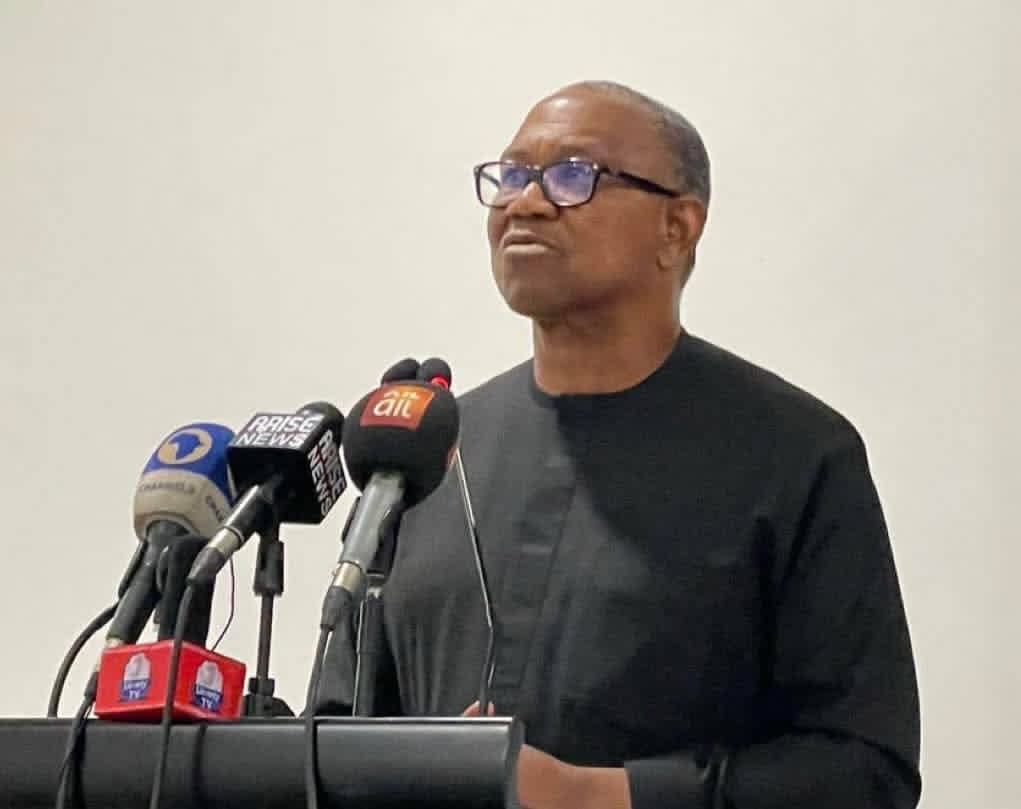
On the other hand, Peter Obi who has gained significant popularity, enough to challenge an incumbent, is yet to get a viable political party structure that could translate his popularity into electoral success. Why? Because of the corruption in the political system where money and other sentiments dictate over reason and merit. So it’s structurally right to say that less than one year to poll, nobody is ready for 2027, both the ruling and the opposition.
In this discussion therefore, we aim to critically analyse the state of democracy in Nigeria, where neither the ruling party nor the opposition is prepared for an election. To illustrate this, we will use a mathematical representation: a failed opposition plus a failed government equals a doomed democracy. (AFO+AFG=ADD)
There is a pressing reason for concern among democratic observers in Nigeria. A thriving democracy relies on either a strong and viable opposition or a capable government—or ideally, both working interdependently. But democracy in Nigeria is precarious, this is evident in the dysfunction between the opposition and the government, and becomes even more disastrous when both are unhealthy.
In 2015, Nigeria gained significant global attention within the democratic community when an incumbent federal government was defeated, leading to a seamless transition of power from the Peoples Democratic Party (PDP) to the All Progressives Congress (APC). This event was hailed as un-African, significantly enhancing Nigeria’s democratic standing. However, eleven years later, the APC, the party that benefited most from that rare democratic shift, has become the biggest obstacle to democracy in the country. Today, Nigeria’s governance is anything but democratic.
With the 2027 elections approaching, President Bola Ahmed Tinubu, who ascended to power by promoting a grab-and-run approach to democracy, is actively undermining democratic principles. He is strategically positioning himself to consolidate power over all political parties and arms of government. He has managed to quarantine the judiciary and legislature, rendering them copiously subordinate to the executive arm while also encroaching upon the press and civil society, all on his path toward a one-party state and the installation of dictatorship in the land.
The 2023 presidential candidate for the Labour Party, Peter Obi tried to strengthen the opposition’s position by maintaining relevance and visibility since the last elections. Ideally, this would have helped to create a rallying figure for the opposition to coalesce and effectively challenge the underperforming ruling APC. However, it is disheartening to observe that, months before the elections, the opposition remains fragmented and lacks a cohesive strategy—the ruling APC government despite benefiting from its incumbency, is actively deploying both treachery and strategy for 2027 trying to deny Obi a platform.
Over the past year, President Tinubu’s administration has seemingly abandoned governance to focus on political manoeuvring. Even his frequent trips abroad, faked as a foreign investment mission, appear aimed at garnering support from international interests for the upcoming elections. Discussions are ongoing regarding enhancing their election rigging strategies.
In a typical political landscape, it is often the opposition that exerts extraordinary effort as the underdog. Yet, as we approach the 2027 elections in Nigeria, the situation is reversed; the opposition is in disarray. While it is clear that the ruling party has significantly influenced the current challenges facing the opposition by manipulating the judiciary, legislature, and electoral body against them. Sadly, the opposition is not effectively shouldering the responsibility of taking decisive action to escape their predicament.
The atmosphere surrounding the democratic community in Nigeria today is far from the enthusiasm one would expect in an election year. Instead, it presents a grim and sobering reality. When activities are consigned to stagnation and finger-pointing, it feels as though the entire democratic project is on the brink of collapse.
In a functional democratic system, the government is responsible for providing vision and execution, while the opposition plays a critical role in scrutiny and offering alternatives. When both pillars falter, a political vacuum emerges, often filled with apathy, populism, or worse.
The picture is real that as we approach the general election in less than a year, Nigeria is witnessing a complete disintegration of its democratic engine.
The failures of the government are glaringly evident, marked by incompetence, corruption, and an inability to tackle essential issues such as corruption, inflation, safety, and infrastructure.
This failure is eroding public trust in the state’s efficacy. Simultaneously, the opposition’s shortcomings are insidious; it is fragmented, disconnected, and largely “protest-based,” lacking a viable plan to provide a real safety net. Voters find themselves trapped in a dismal predicament—they detest the current trajectory but fear the uncertainty of the alternatives.
This situation fosters pervasive cynicism, where neither side feels like a viable option, resulting in disengagement from the political process. Low voter turnout and the erosion of civic trust are harbingers of a democracy spiralling into a “doom loop.” These troubling signs were glaringly evident during the just-held FCT local government polls on February 21, which served as a test run for the general election next year.
But a question arises,is there a path forward? Can we hit a reset button in the next eleven months? Historical patterns suggest that when both the ruling and opposition parties fail the public, democracy often takes one of two paths: the rise of outsiders—a new movement or “disruptor” figures—or a push for institutional reform driven by grassroots pressure for structural changes, such as ranked-choice voting or campaign finance reform, which can bypass the failing parties.
Democratic optimists argue that democracy is never truly “finished” until the people abandon the belief that it is worth the effort to repair. Democracy is a dynamic, messy struggle rather than a static state. If the current situation in Nigeria does not align with this narrative, we must seriously question the state of affairs.
In conclusion, if you find yourself frustrated with the way democracy is practised in Nigeria, consider this quote from the eighteenth-century Scottish historian Alexander Fraser Tytler: “A democracy cannot exist as a permanent form of government. It can only last until the voters discover that they can vote themselves benefits from the public treasury. From that point forward, the majority will always choose candidates who promise the most from the public funds, leading to a collapse of democracy due to loose fiscal policy, which is often followed by dictatorship.
The average lifespan of the world’s greatest civilisations has been around 200 years. These nations typically progress through the following stages: from bondage to spiritual faith; from spiritual faith to great courage; from courage to liberty; from liberty to abundance; from abundance to selfishness; from selfishness to apathy; from apathy to dependence; and from dependence back into bondage.” Where are we Nigerians? God help us.
Abonyi contributed this piece from Abuja